
Navigations are at the top.
Hi there!! Our team is working on this project called......
The Universe
Which means that we must use the knowledge we have gathered during the few lessons of AEM, to create a page which revolves around The Universe. The process of learning these webs was tedious, but we have managed to overcome the difficulties. Planning a web page on this topic was difficult, but our team stuck together and did our part.
There are 6 members in our group. The leader, Jin Gen, and the five other members, Steven, Shan Quan, Rayen, Valerie and Mandy. As all the other groups had only 5 members [except for Kenjie's group], we were required to create 1 extra pipe, which meant that we needed to make 3 Yahoo! Pipes instead of 2.
Thinking of 3 Yahoo! Pipes was a difficult thing for us to do, as we needed to relate all three pipes together.
We started off by creating the blog. We used "th-universe.blogspot.com" as it is what we are doing. The universe. We chose a blogskin that was related to the topic too. As you can see, the image on top has stars in the dark sky. There are many things out there in the universe. Stars, meteorites, galaxies etc.
What are we doing on our 4 Yahoo! Pipes?
More information about each pipe will be given under the respective pipes.
------------------------------------------------------------------------------
We have also included other programmes/applications that we have used.
Such as flickr for pictures, youtube for videos, MindMeister for the mindmap, Scribd for the powerpoint slides, and definitely, Yahoo! Pipes for the maps and pipes (: .
Thursday, November 12, 2009
Source : http://www.mindmeister.com/maps/show/34663174
Information on the Universe
3:20 PMThe Universe comprises everything that physically exists,
the entirety of space and time, all forms of matter and energy.
It is uncertain whether the size of the Universe is finite or infinite.
According to the prevailing scientific model of the Universe, known as the Big Bang, the Universe expanded from an extremely hot, dense phase called the Planck epoch, in which all the matter and energy of the observable universe was concentrated.
Since the Planck epoch, the Universe has been expanding to its present form,
possibly with a brief period (less than 10−32 seconds) of cosmic inflation.
Several independent experimental measurements support this theoretical expansion and, more generally, the Big Bang theory. Recent observations indicate that this expansion is accelerating because of the dark energy, and that most of the matter and energy in the Universe is fundamentally different from that observed on Earth and not directly observable.
Source: http://en.wikipedia.org/wiki/Universe
Universe Game
4:33 AM
source: http://www.mofunzone.com/online_games/impactus.shtml
last edited: 13/11/09 1.31pm
The Four Yahoo! Pipes
1:18 AMA map to display observatories around the world
News and Pictures on Universe
Search for Telescopes on Ebay based on price
Craters on Earth
History of the Universe
1:11 AM
Pictures on the Universe
12:05 AM
source: photobucket
Source: http://en.wikipedia.org/wiki/File:Hubble_ultra_deep_field_high_rez_edit1.jpg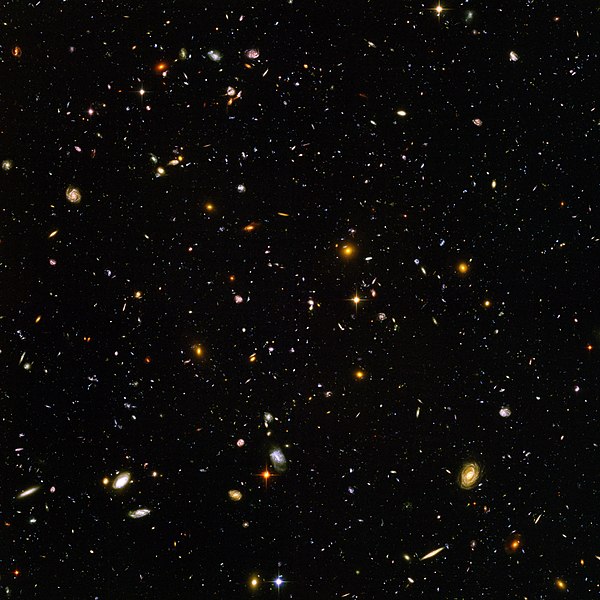
source : http://smartpei.typepad.com/.a/6a00d83451db7969e201157051995d970b-800wi


Meteors
A meteor is a bright streak of light that appears briefly in the sky. Observers often call meteors shooting stars or falling stars because they look like stars falling from the sky. People sometimes call the brightest meteors fireballs. A meteor appears when a particle or chunk of metallic or stony matter called a meteoroid enters the earth's atmosphere from outer space. Air friction heats the meteoroid so that it glows and creates a shining trail of gases and melted meteoroid particles. The gases include vaporized meteoroid material and atmospheric gases that heat up when the meteoroid passes through the atmosphere. Most meteors glow for about a second.
Most meteoroids disintegrate before reaching the earth. But some leave a trail that lasts several minutes. Meteoroids that reach the earth are called meteorites.

Stars
A star is a massive, luminous ball of plasma that is held together by gravity. The nearest star to Earth is the Sun, which is the source of most of the energy on Earth. Other stars are visible in the night sky, when they are not outshone by the Sun. Historically, the most prominent stars on the celestial sphere were grouped together into constellations, and the brightest stars gained proper names. Extensive catalogs of stars have been assembled by astronomers, which provide standardized star designations.

Sun
The Sun is the most prominent feature in our solar system. It is the largest object and contains approximately 98% of the total solar system mass. One hundred and nine Earths would be required to fit across the Sun's disk, and its interior could hold over 1.3 million Earths. The Sun's outer visible layer is called the photosphere and has a temperature of 6,000°C (11,000°F). This layer has a mottled appearance due to the turbulent eruptions of energy at the surface.