
Navigations are at the top.

source: photobucket
Source: http://en.wikipedia.org/wiki/File:Hubble_ultra_deep_field_high_rez_edit1.jpg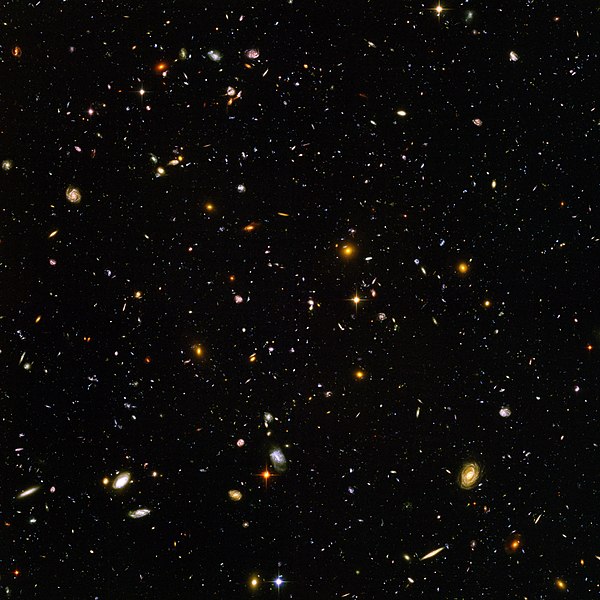
source : http://smartpei.typepad.com/.a/6a00d83451db7969e201157051995d970b-800wi


Meteors
A meteor is a bright streak of light that appears briefly in the sky. Observers often call meteors shooting stars or falling stars because they look like stars falling from the sky. People sometimes call the brightest meteors fireballs. A meteor appears when a particle or chunk of metallic or stony matter called a meteoroid enters the earth's atmosphere from outer space. Air friction heats the meteoroid so that it glows and creates a shining trail of gases and melted meteoroid particles. The gases include vaporized meteoroid material and atmospheric gases that heat up when the meteoroid passes through the atmosphere. Most meteors glow for about a second.
Most meteoroids disintegrate before reaching the earth. But some leave a trail that lasts several minutes. Meteoroids that reach the earth are called meteorites.

Stars
A star is a massive, luminous ball of plasma that is held together by gravity. The nearest star to Earth is the Sun, which is the source of most of the energy on Earth. Other stars are visible in the night sky, when they are not outshone by the Sun. Historically, the most prominent stars on the celestial sphere were grouped together into constellations, and the brightest stars gained proper names. Extensive catalogs of stars have been assembled by astronomers, which provide standardized star designations.

Sun
The Sun is the most prominent feature in our solar system. It is the largest object and contains approximately 98% of the total solar system mass. One hundred and nine Earths would be required to fit across the Sun's disk, and its interior could hold over 1.3 million Earths. The Sun's outer visible layer is called the photosphere and has a temperature of 6,000°C (11,000°F). This layer has a mottled appearance due to the turbulent eruptions of energy at the surface.